
Orange County Home Prices Are Still High — But Rising Mortgage Rates Are Changing the Market
Orange County home prices remain remarkably resilient, but the market buyers and sellers are navigating today looks very different from the ultra-low-rate years.
As of September 2026, the median Orange County home sold for approximately $1.225 million, up about 5.2% from a year earlier. At the same time, the median asking price has declined to roughly $1.299 million, about 3% below last year.
That combination tells an important story.
One of the biggest reasons is mortgage rates.
The average 30-year fixed mortgage rate moved above 7% in late September after climbing noticeably during the month. If inflation pressures, Treasury yields and geopolitical risks remain elevated, mortgage rates could move higher still.
Could rates approach 8% before the end of the year? It is possible, but it should be viewed as a risk scenario rather than a certainty.
For Orange County buyers and sellers, the message isn’t to panic or stop making real estate decisions.
It is to adjust the strategy.
Why Are Mortgage Rates Rising?
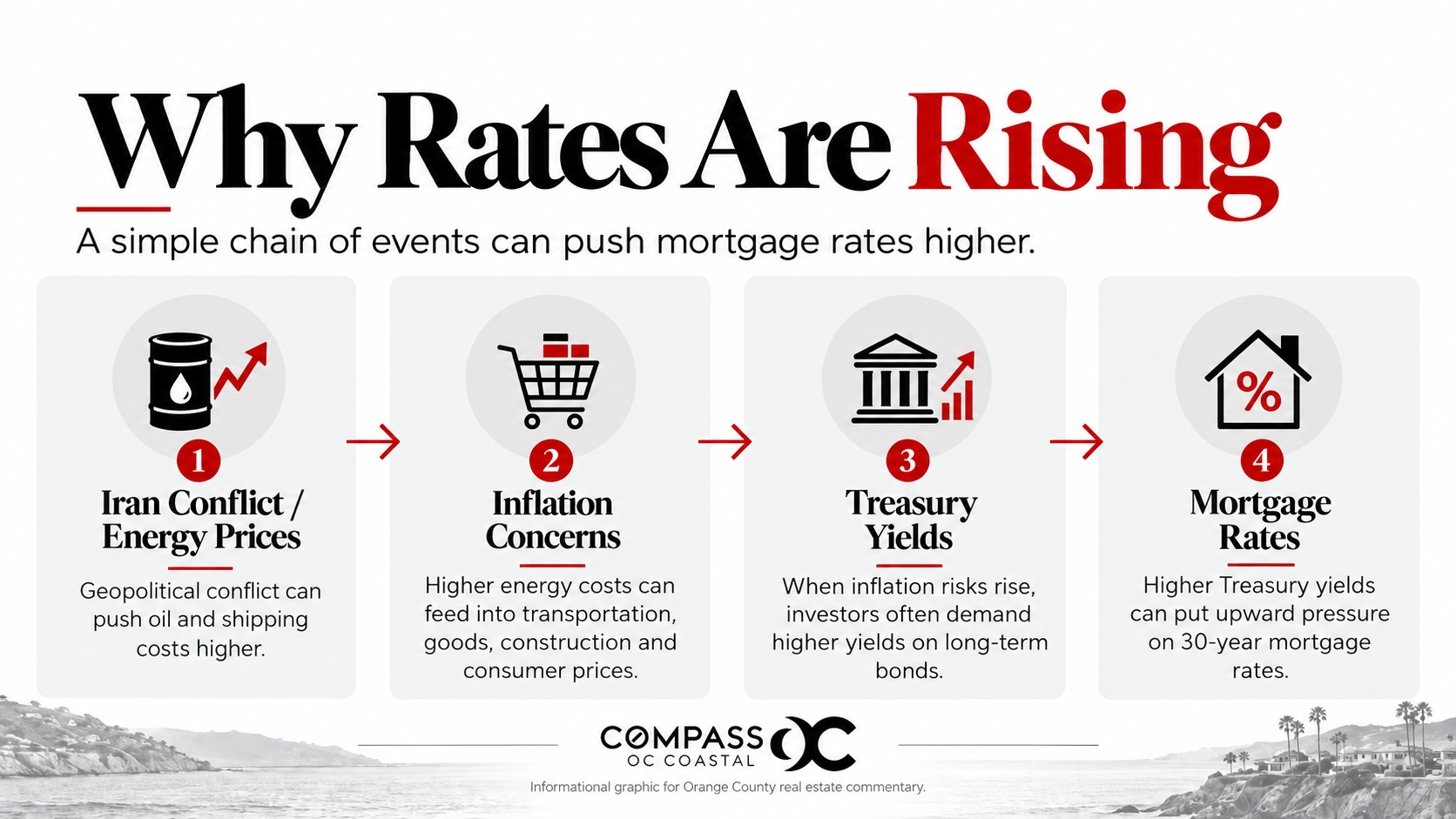
Mortgage rates do not move directly with the Federal Reserve’s short-term interest rate. Long-term mortgage rates are much more closely influenced by the bond market, particularly the yield on the 10-year U.S. Treasury, along with inflation expectations and demand for mortgage-backed securities.
Several forces are currently putting upward pressure on borrowing costs.
1. The War in Iran Is Affecting Energy Markets
The ongoing conflict involving Iran has contributed to higher oil prices and renewed concerns about global energy supplies and shipping.
Why does that matter to somebody trying to buy a house in Orange County?
Because higher energy prices don’t stay at the gas pump.
When bond investors believe inflation may remain elevated, they generally demand higher yields to hold long-term debt. Rising Treasury yields can then push mortgage rates higher.
2. Treasury Yields Have Moved Sharply Higher
The benchmark 10-year U.S. Treasury yield has recently moved above 5%, reflecting a combination of inflation concerns, stronger energy prices, geopolitical risk, economic growth and government borrowing.
That’s particularly important for housing because mortgage rates generally respond more closely to long-term bond yields than to day-to-day headlines about the Federal Reserve.
3. Inflation Is Still a Concern
Recent inflation readings have provided some encouraging signs, but inflation remains above the Federal Reserve’s long-term target.
Higher fuel and transportation costs could add another layer of inflation pressure, particularly if the Iran conflict or other global supply disruptions push energy prices higher for an extended period.
4. The Economy Has Remained Resilient
Stronger economic growth is generally good news, but it can work against borrowers when it comes to interest rates.
A resilient economy, consumer spending and continued business investment can give inflation more room to persist, encouraging investors to expect interest rates to remain higher for longer.
What Higher Rates Mean for Orange County Sellers
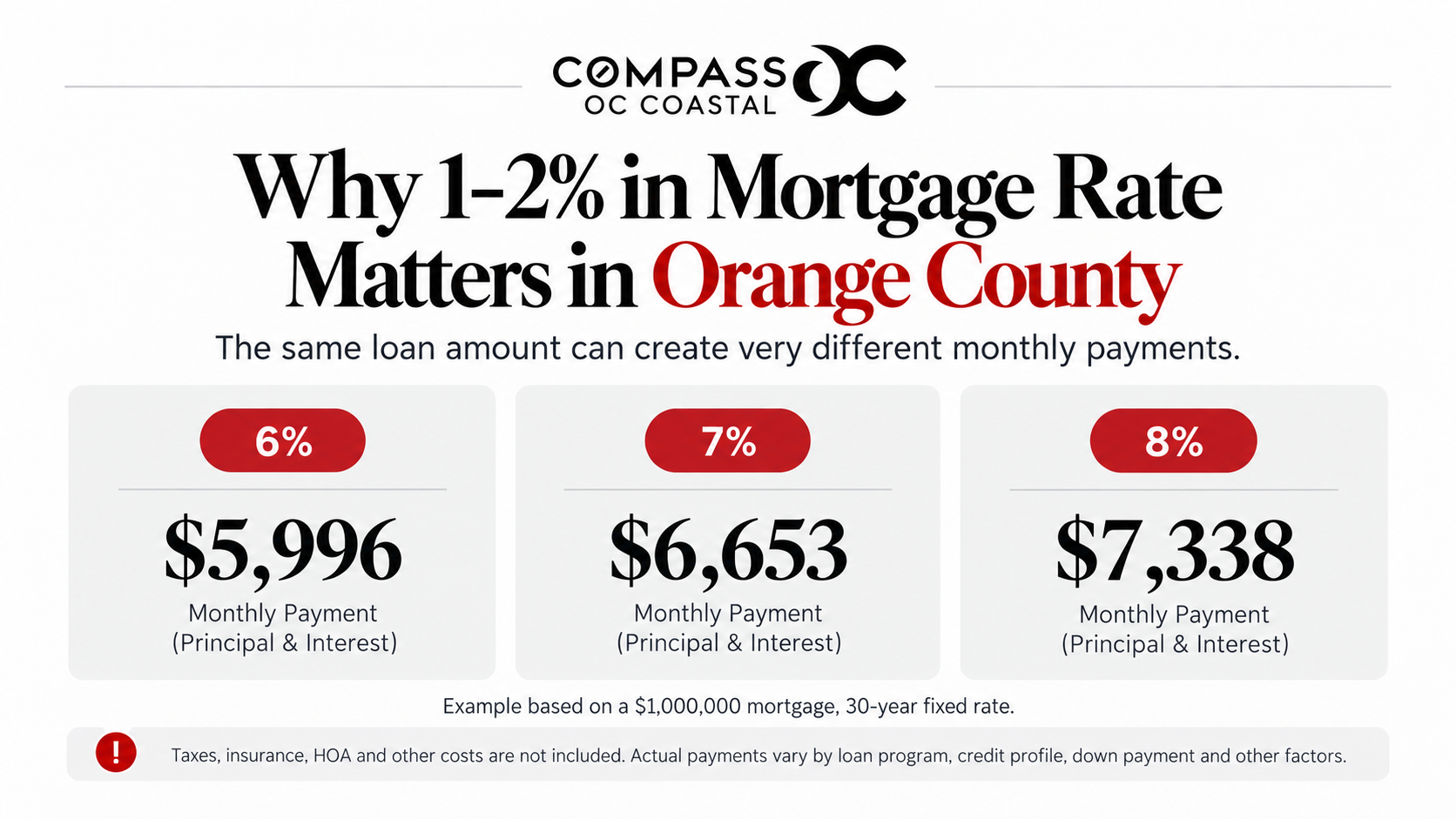
There is an enormous difference. Almost any homeowner can put a price on a property, but the market ultimately determines whether that price is realistic. At Orange County price points, even a modest change in mortgage rates can substantially alter a buyer’s monthly payment and purchasing power.
That means sellers aren’t simply competing against the house down the street anymore. They are competing on price, condition, monthly affordability and total cost of ownership.
Accurate Pricing Matters More Than Ever
Online home-value estimates can be useful starting points, but they can’t fully evaluate the differences that often determine value in Orange County.
An experienced REALTOR® can use multiple tools and market indicators to determine a more accurate listing strategy, including:
- Recent comparable closed sales
- Current competing listings
- Pending sales
- Price reductions
- Days on market
- Buyer and showing activity
- Location within the neighborhood
- Ocean, canyon, city-light or golf-course views
- Lot size and orientation
- Condition and quality of improvements
- HOA dues and special assessments
- Insurance considerations
- Seller concessions on competing properties
- The monthly-payment difference between your property and competing homes
The question is no longer simply:
“What did the house down the street sell for?”
It is also:
“At today’s mortgage rate, what is a qualified buyer willing and able to pay for this home?”
That distinction can be critical.
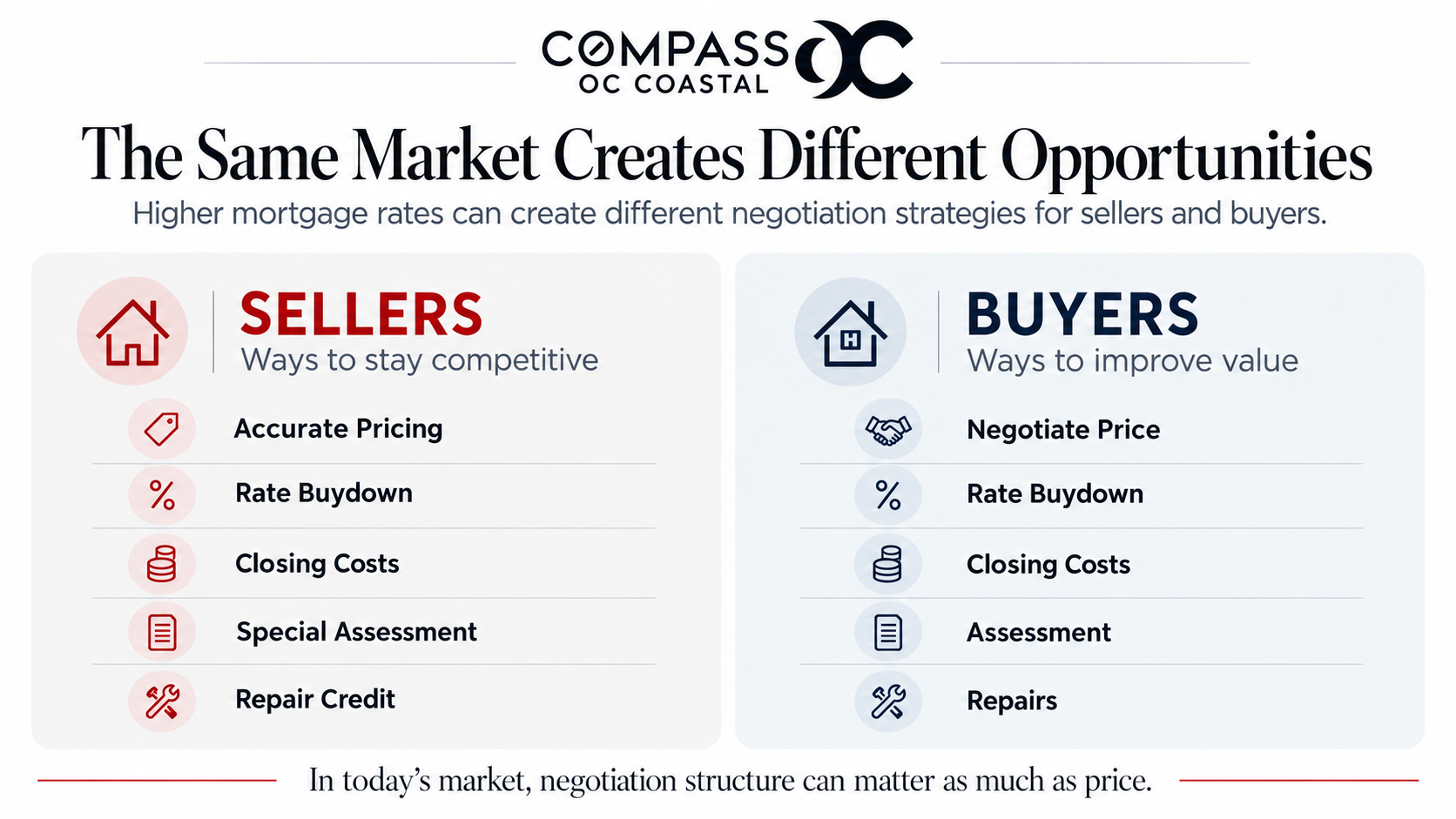
Seller Concessions Can Be Powerful
A seller doesn’t necessarily have to respond to a slower market with repeated price reductions. Sometimes a strategically structured concession can produce greater value for the buyer while protecting more of the seller’s sales price.
Mortgage Point Buy-Down
A seller credit may be used, when permitted by the buyer’s loan program, to purchase mortgage discount points and reduce the buyer’s interest rate. For many buyers, lowering the monthly payment can be more meaningful than receiving an equivalent reduction in purchase price.
Closing-Cost Credit
Seller credits can sometimes help with allowable buyer closing costs, reducing the amount of cash the buyer needs to bring to closing.
Prepay a Special Assessment
This can be particularly relevant for Orange County condominium and HOA communities. If a property has an outstanding special assessment, a seller can consider paying some or all of that obligation at closing rather than asking the buyer to inherit the expense. Removing that financial uncertainty can make the property significantly more attractive.
Repair or Improvement Credits
Rather than making every repair before listing, sellers may be able to negotiate an appropriate credit, subject to the buyer’s loan requirements.
Home Warranty
A home warranty is relatively inexpensive compared with the price of an Orange County home and can provide additional reassurance when appliances or major systems are older.
Other Negotiating Tools
- HOA transfer fees
- Prepaid HOA expenses where appropriate
- Temporary interest-rate buydowns
- Permanent mortgage discount points
- Repair credits
- Closing-cost assistance
- Flexible possession or closing dates
- Included appliances or furnishings
- Credits toward deferred maintenance
Buyers Have Negotiating Tools Too
Higher rates create challenges for buyers, but they can also create opportunities. When fewer buyers are competing for each property, qualified buyers may gain negotiating leverage that was virtually nonexistent during the frenzy of the ultra-low-rate market.
Instead of asking only:
“Will the seller take less?”
Buyers should consider the entire transaction.
- Will the seller reduce the purchase price?
- Will the seller contribute toward mortgage points?
- Will the seller provide a temporary rate buy-down?
- Will the seller pay eligible closing costs?
- Will the seller pay an outstanding special assessment?
- Will the seller provide repair credits?
- Will the seller provide a home warranty?
- Can price and concessions be combined to reduce the buyer’s total cost?
In today’s market, negotiating the structure of the transaction can be every bit as important as negotiating the purchase price.
For Buyers: “Date the Rate. Marry the Home.”
Interest rates change. The right home may not still be available when they do. If today’s payment works comfortably within your budget, buying when other purchasers are hesitant can sometimes provide opportunities to negotiate terms that disappear when rates decline and buyer demand increases.
If mortgage rates decline in the future, refinancing may become an option. But buyers should never purchase a home they cannot comfortably afford today based on the assumption that a future refinance will solve the problem.
Buy the home because today’s numbers work. Consider a future refinance potential upside—not part of the requirement for making the purchase affordable.
Price Isn’t the Only Number That Matters
Consider two comparable Orange County homes.
| Seller A | $1,300,000 | No concessions |
| Seller B | $1,300,000 | Seller credit toward eligible mortgage costs |
Depending on the buyer’s loan program and financial situation, Seller B’s property could produce a significantly lower effective monthly cost without requiring the seller to make an equivalent permanent reduction in the home’s recorded sales price.
That’s why today’s negotiations increasingly revolve around:
Not purchase price alone.
Are Orange County Home Prices Falling?
Countywide data does not currently show a collapse in Orange County home values. Recent market data shows the median sold price at approximately $1.225 million, roughly 5.2% higher than a year earlier. But there is an important difference between home values remaining high and every seller having unlimited pricing power. The median listing price has softened, buyers face much higher financing costs, and homes are increasingly being evaluated property by property.
That is especially true across South Orange County. The market for Dana Point real estate can behave differently from Laguna Niguel real estate. Likewise, Laguna Beach homes often respond differently to market changes than properties in San Clemente. Even within the same community, a remodeled ocean-view property can behave very differently from a dated home only a few streets away. That’s why countywide averages are useful—but they aren’t a substitute for analyzing the specific home and neighborhood.
Sellers: Don’t Chase the Market Down
One of the most expensive mistakes a seller can make is intentionally overpricing because:
“We can always reduce it later.”
That’s technically true. But the first weeks on the market usually generate the greatest buyer attention. If a property’s initial price is materially higher than what buyers believe today’s market supports, buyers may simply move on.
Days on market begin accumulating. Then comes the first reduction. Then perhaps another. Eventually the seller may accept less than could have been achieved by pricing the home correctly at the beginning.
Buyers: Higher Rates Don’t Mean There Are No Opportunities
Nobody likes a 7% mortgage rate. An 8% mortgage rate would obviously make affordability even more challenging. But buyers should remember what often happened when rates were dramatically lower:
- Multiple offers
- Bidding wars
- Homes selling almost immediately
- Reduced negotiating leverage
- Fewer seller credits
- Buyers waiving or shortening contingencies
Higher rates can reduce competition. A financially prepared buyer may now be able to negotiate price, mortgage credits, repairs, assessments and closing costs in ways that were far more difficult in a hypercompetitive market.
Sometimes opportunity appears when fewer people are competing for it.
Orange County Real Estate: The Bottom Line
Orange County homeowners continue to own some of the country’s most valuable residential real estate. But mortgage rates above 7% are changing the way that value needs to be marketed, financed and negotiated.
For sellers, today’s market increasingly rewards:
- Accurate pricing
- Strong presentation
- Property-specific market analysis
- Strategic concessions
- Experienced negotiation
For buyers, the same environment can create opportunities to negotiate terms that may not exist when mortgage rates eventually decline and more purchasers return to the market.
No one can know with certainty where mortgage rates will finish the year. Rates could ease. They could remain near current levels. Continued inflation, higher Treasury yields or additional geopolitical disruption could also push rates closer to 8%.
The better strategy isn’t trying to perfectly predict the interest-rate market.
Thinking About Buying or Selling in Orange County?
Whether you’re determining the right listing price, evaluating seller concessions or deciding whether today’s market creates a buying opportunity, the numbers should be analyzed property by property.
Market statistics and mortgage-rate information are intended for general informational purposes and may change. Mortgage rates vary by borrower, loan program, lender, credit profile, down payment and other factors. Buyers should consult a qualified mortgage professional regarding available financing and seller-contribution limits.